HTS1-Crafting Historical Arguments from Historical Evidence
-My Reflection-
Throughout the year I have developed the ability to understand and identify evidence about the past using sources like documents, paintings, and pictures. Something that has helped me acquire this skill are the DBQ Essays. These essays helped me practice the way i judge and view articles and other documents related to history. The DBQ Essays helped me to relate what is written or seen in a picture or document to what I already know of history. In order for me to determine the claim or the argument of the document or picture I would first create a SOAPSTONE which is a device that helps me identify the speaker, the occasion, the audience, the purpose, the subject, and the tone of the document or image. With these I can have very strong support for my claim or argument made in my DBQ Essay. Something else that has helped me master the ability to understand and identify the claims being made in a document or image are the March Madness debates. In these debates each student was assigned a specific historical figure and you had to debate others by making strong positive claims of why your leader was the best leader of all history. This has helped me practice my ability to understand and identify claims being made in a document or image because I had to find sources from the internet or my AP World History book that gave positive characteristics about why my leader was the greatest leader of all time. Although, sometime certain sources would give me negative characteristics about my leader, I would use my ability to understand and identify the claims being made in the document to change them to my favor. Now that I know that I've mastered this skill I could apply them to the other classes I take in the future.
-Evidence-
An example of me using my skill of understanding and identifying claims of different documents and images is in this DBQ Essay I was assigned in my AP World History class. In the following essay I demonstrate the different attitudes the Han Dynasty and the Roman Empire had towards technology by using different documents and images to help me create an argument to support the prompt.

|
DBQ Essay.docx Size : 15.189 Kb Type : docx |
HTS2-Chronological Reasoning
-My Reflection-
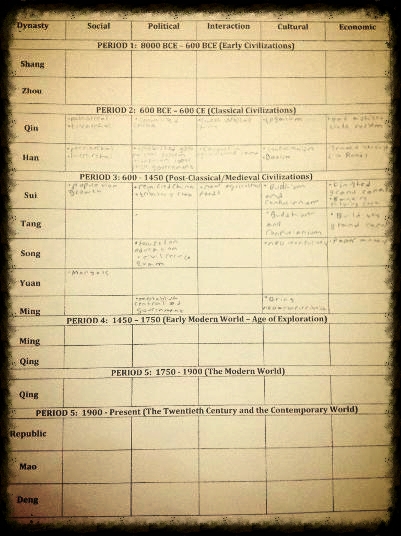
During my time in AP World History I learned how to identify, analyze, and evaluate the relationships between multiple historical causes and effects. I learned how to do this by practicing this skill on my Change Over Time Essay's given to me throughout the year. In these essay's I would describe the changes in a civilization and analyze events that had happened in the era. We were expected to know all time periods from 8000 B.C.E-600 B.C.E., 600 B.C.E-600 C.E.,-600 C.E.-1450,1450-1750,-1750-1900, and from 1900-the present. Although we had to know all of these time periods in order to identify, analyze, and evaluate the relationships between historical causes and effects, an easy way to remember events that happened during these time periods is by using the Chinese Dynasty Song. The Chinese Dynasties in chronological order: Shang, Zhou, Qin, Han, Sui, Tan, Song, Yuan, Ming, Qing, Republic, Mao, Deng. By using the Chinese Dynasty Song I can relate the dynasty to its time period and then relate it to events in the world happening in the same time period.
-Evidence-
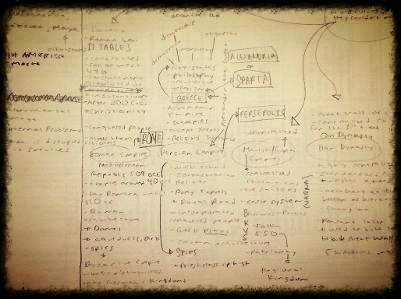
I learned how to remember significant events in history by relating what Chinese Dynasty was in power during a specific time period. For example, during the years 600-1450, by using the Chinese Dynasty Song I know that the Sui, Tang, Song, Yuan, and Ming dynasties were in power somewhere between these time periods. Then, by relating what I already know, I can relate this time period and Chinese Dynasties to Christopher Columbus's voyage of the Atlantic Ocean and his "discovery" of the Americas. I can also relate it to Zheng He's expeditions after previous invasions by the Mongols. Below are pictures of the Chinese Dynasty Song and the different connections you can make with other events in history by using this song.
 |  |
HTS3- Comparison and Contextualization
-My Reflection-
Learning to evaluate and compare and contrast one or more societies is another skill I learned during my year in AP World History. This skills are used when you have to describe the difference and similarities between two or more societies according to the prompt. I practiced this skill throughout the year by writing Compare and Contrast Essay's. When I would write Compare and Contrast Essay's I would compare the main AP themes which are, Social, Political, Interaction, Cultural, and Economic. I would remember these five main AP themes with SPICE which make up the first letter of each of the AP themes. I used these themes and I would compare both societies given in the prompt. Sometimes the prompt would not ask for specific comparisons so what I would do is that I would write down all five AP themes and I would write down all similarities and differences between both societies in all the themes. Then, I would would write my essay with the themes I have the more information on in order to complete my Essay.
-Evidence-
Comparison Essay's were the essay's that helped me gain the skill of comparing and contrasting one or more societies. In the following Comparison Essay I had to compare the similarities and differences between Latin America and North America. I believe the following Essay is good evidence to demonstrate that I have acquired the skill to compare and contrast one or more societies.
|
|
Latin and North America.docx Size : 14.237 Kb Type : docx |
HTS4-Historical Interpretation and Synthesis
-My Reflection-
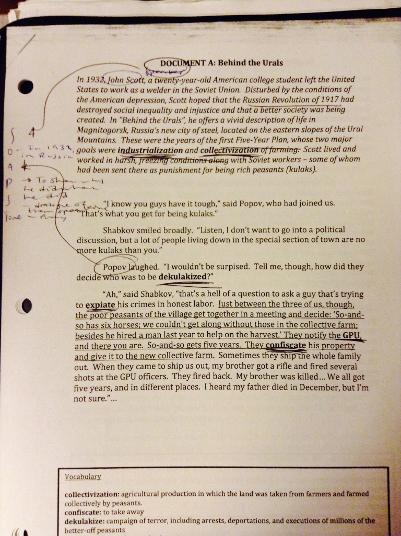
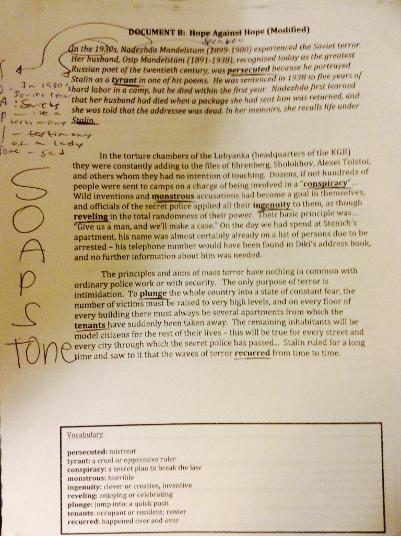
The skill to describe, analyze,evaluate, and create diverse interpretation of the past is another historical thinking skill I've acquired in my AP World History class. You use this skill to analyze the evidence, find what the context is saying, find the point of view, and the frame of reference revealed through primary and secondary histoical sources. Something that has helped me practice and eventually master this skill was through the use of the mnemonic, SOAPSTONE. Each letter helps me remember to find the following key things in a primary and secondary source, speaker, occasion, audience, purpose, subject, and tone of the document or source. This skill has helped me better understand what a document is saying and to analyze what the author or speaker is saying.
-Evidence-
The following images are some documents which are part of a DBQ Essay I was assigned. They show my annotations and how I use SOAPSTONE to analyze and interpret each document or source. With SOAPSTONE I was able to finish the essay by correctly using each document with the help of SOAPSTONE.
 |  |
